ekottomagazine

NO. 51 - JUNIO 2026

Cultural Magazine - Revista Cultural
TABLE OF CONTENTS
The Power of Culture
Rijole Bitata Sopale
Rijole Bitata Sopale
Photos and video

Bioko: Between the Natural and the Harmful
"Count in Ëtyö" por Biëtáa Niima Jen Tyes
Waíssö, Rihóllè Rillé
Culture, Society, Plus More


ekottomagazine.com
Ë KOTTÒ, is a magazine of the cultural field in all its disciplines.
We are committed to bringing culture closer to our readers. Our goal is to give visibility to sectors that lack this opportunity of presence in large media platforms.
Our publications will be monthly and will focus on four basic sections and four complementary sections.
EDITORIAL, INFORMATION, INTERVIEWS, ACTIVITIES.
1. EDITORIAL: A general account of a specific topic in each edition.
2. INFORMATION: Its content will be based on learning about our guests' backgrounds, or what could be called their résumés.
3. INTERVIEW. Focused on the professional sphere.
4. ACTIVITY: Focused on our guest's current activities.
OPINION
It is a section for sociocultural opinion articles.
SOKKÒ
It is a section with a variety of socio-cultural news.
POET'S BLOG
A section for poetry and poems.
EMPLUSTV
Ekotto magazine channel on YouTube.
Culture, society, plus more.
With the magazine Ë KOTTÓ, we will bring culture a little closer to our homes.
Editorial
THE POWER OF CULTURE
Although culture sometimes takes a back seat in the day-to-day life of our societies, its power is immense and awe-inspiring, because it is one of the tools that breaks down walls and creates connections that unite diverse societies to share history and identity.
When you are part of one of those cultures mislabeled as “minority” but which, in one way or another, always find a ray of light that offers them the opportunity to reach the world through a poem, a song, a dance, etc., you perceive the importance and power of culture in general and, particularly, of the culture that represents you.
The Bubi culture and language, one of the oldest in Africa, can never perish for those of us who are part of this world heritage. That is why, the more they are known in the world and the more they are promoted in any setting, the more their existence is guaranteed.
And the tenth anniversary of the African Reading Club of Mallorca is proof that all the world’s cultures are necessary, because they are the force that unites, strengthens, and enriches diversity.
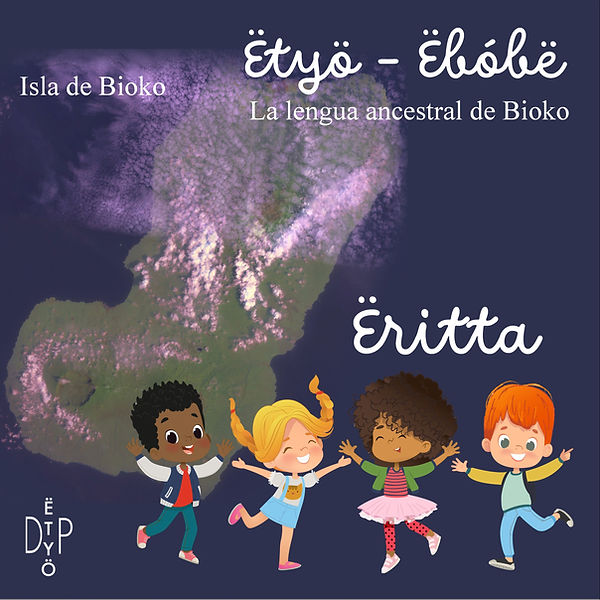
Within the pages of this 51st issue of Ëkottò magazine, you’ll find literary and learning resources that can help our readers discover the Bubi language and culture.
We’re also premiering the program La Entrevista on the EmplusTV platform. Don’t miss it.
Story
RIJOLE BITATA SOPALE

My name is Rijole Bitata Sopale. I was born in Palma de Mallorca in the late 1970s. I studied to become an English teacher, driven by my interest in languages and my desire to keep my ability to communicate in more than one language alive.
I was fortunate enough to hear Ëtyö spoken at home. Although I acquired a basic knowledge of the language, there were no cultural spaces in Mallorca where I could deepen and expand that learning.
I have worked in the British education system for many years. Throughout my career, I have always focused my work on educational initiatives that highlight and celebrate the contributions of our people in all academic fields.
Thanks to government grants and private donations, I was able to found STEAM POWER, an organization dedicated to creating opportunities for our community in the fields of science, technology, engineering, art, and mathematics.
I currently serve as president of Ölöita lué Ësèsèmbè, a cultural organization committed to preserving the culture of the Bóóbe people. I am convinced that it is essential for each of us—especially the younger generations—to embrace our identity unfiltered and with pride.
Interview
RIJOLE BITATA SOPALE
Káwëlè Rijole?
Thank you for accepting our invitation.
1. You were born in Palma de Mallorca but have roots on the island of Bioko. How has this dual identity influenced the way you see the world?
To keep them in the dark, I was born during a period of cultural revival in Mallorca. I remember the debates, I remember the factions: Catalan nationalists vs. Mallorcan nationalists. I think I was born in a distinctly Mallorcan nationalist enclave. La Penya Güell had a bar about a fifteen-minute walk from my house. That bar was a landmark: I look back on it now with the eyes of an adult. They had the flag displayed at the entrance or on the building’s facade, and I remember, on more than one occasion, the stares I got when I had to go in to place a bet on the lottery or the Primitiva.
In that atmosphere, it was very clear to me that I wasn’t Mallorcan, nor Spanish, and, above all, that I wasn’t white. I knew I was in a place where I had nothing in common with anyone.
At school we had to learn Catalan, and even then I sensed that it wasn’t just about speaking a language: it came with a cultural baggage that many people—especially those from the mainland—couldn’t or wouldn’t bear.
Although I didn’t know what it meant to be Böóbe, I knew from a very early age that I was black, as they said, but I didn’t back down (Victoria Santa Cruz, 1978). Even so, I grew up with the anxiety of entering public spaces and being met with that uncomfortable silence, those looks of fascination, that dismissive attitude.
The attitudes of outsiders were a constant reflection of the kind of environment I faced: classmates, teachers, the baker, the supermarket cashier… I think my identity was also shaped because at home we never opened the door to just anyone. In fact, only one white person ever came up to our home when we were children. Unfortunately, they passed away, and I remember they were the only person who gave my siblings and me stuffed animals one Christmas.
Our home was our space. There was order, in the sense that we were the center, no one else. The portrait of my paternal grandparents presided over the living room, alongside that of our instrument. There were no religious figures or elements that would displace us from that center. Our friends weren’t allowed to come up, and we weren’t allowed to go to anyone else’s house.
The message was clear: “together, but not mixed up.”
Knowing that I belong to an island goes beyond the physical territory. If Bioko were to disappear tomorrow, I would still know what my cultural identity is.
You grew up listening to Ëtyo at home. What does this language mean to you today?
Language is not just a tool for communication: it is a way of thinking. It is the projection of our imagination, our worldview, our way of seeing the world. When we speak other languages, we must be aware that we are operating within the imagination of another group. It is like experiencing reality through someone else’s eyes.
For me, it is essential to know that I can disconnect and look at the world again through our own lenses.
I have met people who boast about not speaking “that.” I don’t blame them. Many of our elders knew no other reality under colonial rule. For those who don’t know, there were two legal categories: emancipated and non-emancipated. Members of the Böóbe community had to choose between following the colonists’ rules or maintaining their customs. Those who chose the former stopped speaking the language to their children and, even once in Spain, fostered relationships with Spaniards. It was a way to preserve privileges at the cost of cultural suicide.
My parents spoke Ëtyö among themselves. We listened, but what I remember most are the songs and dances. I especially remember my mother singing while she cooked. My father had a guitar, but he stopped playing it when we were very young.
Something that has always struck me is that my parents said I could speak the language and didn’t know how I had learned it. With my siblings, it was different: in the interest of integration, they decided not to speak to us in our mother tongue for a long time.
2. Can you recall a specific moment when you felt the need to reconnect more deeply with Bubi culture?
Culture is something you experience. I went to the island for the first time when I was 30. I didn’t see any culture there. My aunt was surprised that I could communicate in our language.
The community in Spain doesn’t live the culture and, therefore, hasn’t passed it on. We like to say we’re “Bubi,” but few know what that really means, especially among those born abroad. Without a community that celebrates its identity, it is very difficult to sustain it.
I went through a period of rejection and frustration, feeling that the older generation wasn’t passing on the culture and, moreover, showed little patience. Sometimes they even ridiculed or ignored me. I know people who, in their search, found no support within the community and ended up learning African dances from other places.
When there is resistance, silence, or mockery within one’s own community, there is a risk of breaking intergenerational respect. There is a significant disconnect: although we no longer live under colonial rule, a mindset persists where what is “Spanish,” what is “authentic,” and academic titles remain a source of pride.
You studied to become an English teacher. What drew you to teaching and languages?
To be honest, I didn't have a particular interest in teaching. I was interested in languages, especially English, because I wanted to travel. My first choice was to study translation, but that wasn't possible at the time, so I decided to pursue a degree in English Language Education.
3. You’ve worked in the British education system for many years. What lessons would you highlight from that experience?
In the British education system, there is no real diversity in the curriculum. Despite being a country with a long colonial history, cultural representation is often confined to a single month each year.
However, its education system has its strengths, particularly in promoting reading. School libraries are enormous.
It is also a country with significant social inequalities. In Spain, that difference isn’t as visible. For example, here the rich and the poor might cross paths in the same supermarket; in the United Kingdom, they don’t.
4. Throughout your career, you have been committed to highlighting the contributions of our community. Why is this still necessary?
Because the dominant narrative remains the same: Who dies in the Mediterranean? Who represents global hunger? Who is portrayed as the constant victim?
From childhood onward, images shape our perceptions. In books and illustrations, it’s already determined who is beautiful, who is human, who is the doctor, who is the queen.
You go to a bookstore and you always see the same thing. And yet there are still those who say, “We’re in their country.” It’s my country, too.
Our children don’t know the dark history, nor the history of the island.
5. What obstacles did you encounter when trying to incorporate diverse cultural perspectives into the educational setting?
I wouldn’t say there are any direct obstacles. The curriculum serves a specific purpose, but there’s room for flexibility within that framework: you choose the books, the music, and the role models.
Everything I do, I do independently. It’s unlikely that there’s legislation that captures all of history’s diversity.
In the United Kingdom, they were already beginning to include Afro-Caribbean and African contributions. There were different waves of migration there, each with distinct realities.
In Spain, I see it as more difficult. There’s no commitment to a distinct cultural education; integration is prioritized, but I don’t think it really works.
6. You founded STEAM POWER. How did the idea come about, and what impact has it had so far?
It arose from the need to change narratives. The contributions of the continent and the diaspora are often limited to sports or entertainment, especially in the U.S. context.
We need to explore other areas so that new generations can have a broader, more open-minded perspective.
7. What role do STEAM disciplines play in empowering historically marginalized communities?
These are tools for solving problems that directly affect the community. The more people who get involved in these areas, the less reliance there will be on outside assistance. Knowledge enables us to solve problems from start to finish.
8. You currently serve as president of Ölöita lué Ësèsèmbè. What are its main objectives?
We need spaces for healing and cultural empowerment: places where we can grow as individuals and develop a deep love for our community, both in Spain and in the diaspora.
9. Cultural preservation is one of your key priorities. What actions do you consider urgent?
We need a digital revolution. Language must be accessible to everyone.
Older people possess the knowledge, but many lack digital skills. Young people must build bridges.
If you know someone with a story, record it, edit it, share it.
We can create digital libraries, gather resources, and make them accessible.
Language and singing workshops are key: we’ve been developing them for two years.
10. You talk about embracing one’s identity “unfiltered and with pride.” What does that mean in practice?
It means stopping using culture as a disguise.
Many cultural expressions appear only in celebrations that follow frameworks foreign to our traditions.
If we say we are Bôóbé, we must express it naturally, without being influenced by money or external validation.
11. What has your journey of identity formation been like, balancing Spain and your African roots?
It hasn't been easy.
Resources are scarce. Identity is also shaped by the media, and we aren't represented there.
If you want to learn the language, you can’t turn to Google. If you’re looking for educational resources, there are no places to find them.
That’s why I use social media to connect with the community. If your last name is Böóbe, I’ve probably reached out to you.
I’ve created materials and share them on YouTube, TikTok, and WhatsApp. Platforms like Canva help bring our culture to more people.
12. What role do education and culture play in combating prejudice?
They are essential, but we must accept that we do not need external validation.
We can create our own frameworks for cultural transmission.
Prejudice will not disappear, because there are systems that perpetuate it. Our duty is to strengthen self-esteem within the community.
If we want spaces free of prejudice, we must create them.
13. Looking ahead, what legacy would you like to leave behind?
An educational institution that ensures the continuity of learning and a cultural presence in Europe.
We must leave our mark and prepare the next generation.
14. What would you like to improve in Ölöita lué Ësèsèmbè?
More dialogue with the community and more in-person activities throughout the year.
15. How do you envision the next annual event?
This year it will be held in Ciempozuelos, at the Multifunctional Hall, on August 8.
Happiness begins in childhood — (MÒNÁ PÁASA RIPÉNALÈLÈ ÖNTYÍLÉ)
Thank you for the invitation, Ekottomagazine.
Is there anything else you'd like to add?
I hope this dialogue will continue on August 8 in Ciempozuelos. We are the ones who build our community.
Our team wishes you the best of luck in your new role as leader of the Bubi Youth Association of the Diaspora.
Activity


Celebration of the 10th anniversary of the African book club, MALLORCA.
Founded by Aina Mascaró


Bubi Family Day in New York City


OPINION

BÖSUBÓBBÈ MAY MATA
Bioko: Between the Natural and the Harmful
On the island of Bioko, where nature generously provides fresh, nutritious foods and beverages deeply rooted in local culture, it is concerning to see how sugary drinks, industrial juices, and energy drinks are increasingly gaining ground in everyday life. It is not merely a matter of preference: it is a shift with real—and, in many cases, dangerous—consequences.
These beverages, marketed as modern and appealing, hide an unhealthy reality. High sugar levels, artificial additives, and stimulants like caffeine make regular consumption a health risk. Problems such as obesity, diabetes, and hypertension—once less common in places like Bioko—are beginning to appear more frequently. And what is most concerning is that this consumption is becoming normalized, especially among young people who see these drinks as a status symbol or a sign of belonging to a global culture.
In contrast, the island has natural alternatives that are not only healthier but also part of its identity. Palm wine, for example, is a traditional beverage obtained directly from the sap of palm trees. Rich in nutrients and free from industrial processing, it represents a more balanced and sustainable way of consumption. But it is not the only option: fresh tropical fruits, freshly prepared natural juices, and other local beverages offer hydration and energy without the harmful effects of processed products.
The problem is not only what is consumed, but what is no longer consumed. By replacing the natural with the industrial, not only is individual health affected, but cultural practices, traditional knowledge, and local economies are also weakened. Every imported can that is opened is, in a way, one less opportunity to value and sustain what is our own.
We need to rethink this trend. Choosing the natural is not a step backward; it is moving forward with awareness. It means caring for the body, preserving culture, and strengthening local autonomy. In Bioko, wealth lies not only in its landscapes but also in what springs from its soil. Ignoring that in favor of products that do more harm than good is a luxury we cannot afford.
In the end, true modernity should not be measured by what we consume from outside, but by how we value and protect what we already have.
BÖSUBÓBBÈ MAY MATA


Poet's Blog
EmplusTV
Ë KOTTÒ
Publisher
Diversity Ëtyö Project
Magazine Director
Barbara May
Editor in Chief
Tomás May Pelico
Designer
Böhulá
Colaboration
Eduardo May Mata
ISSN 2833-4124
© 2026
All rights reserved.
May not be reproduced without the written permission of Ë KOTTÒ.
Contact